
From The Desk of the CEO
Don't opt out of AI. Come back ahead.
Five stories from the past two weeks, from AI to a hijacked cockpit to a Nobel Prize, and what they mean for every woman who has paused her career.
Vidya Iyer
Founder & CEO, Unbound Solutions

It is 11:40 at night. The house is finally quiet. You are at the kitchen table, laptop open, a cup of tea going cold beside you. The job application is half done, and the cursor blinks in a box that asks you to explain the gap in your employment. Six years. Two children. One move across the world. You type a sentence, delete it, type it again. Somewhere inside, a voice says: Who are you kidding? Everything has changed. You’re too far behind.
I have sat across the table from hundreds of women at exactly that moment. And for six years, my answer has been the same. You are not behind. You are paused. And a pause is something you can press play on.
This fortnight, the news gave that moment a sharper edge. Five stories caught my eye. Three tell us something important about where women stand. Two remind us what it takes to move.

01
For your career: AI fluency is now a hiring signal. The woman who uses it with healthy skepticism is the one employers need.
Axios · Morgan Stanley survey · Oct 8
Women are souring on AI, while men stay upbeat
You're in a team meeting. Someone across the table says, "I just asked AI and it drafted the whole plan in two minutes." Everyone laughs, impressed. You nod and smile. You haven't opened it once, and part of you doesn't trust it. Part of you is afraid of being seen using it at all.
What happened
A Morgan Stanley poll of 2,000 US consumers in late September found a wide gender split in how people feel about AI. Men’s net sentiment sat around +30; women’s slipped just below zero, down from +6 in April. Women were somewhat more likely to say the technology is moving too fast without enough safeguards.
men's net sentiment on AI
0
+
women's net sentiment, down from +6 in April
-
0
LeanIn’s CEO warned that the AI gender gap must not harden into a chasm, noting that women are often judged for using AI at work while men are praised for it.
My take: Your caution is wisdom, not weakness. Asking "is this safe, is this fair?" is exactly the judgment AI needs. But skepticism from the sidelines doesn't shape anything. Skepticism from inside the room does.

02
For your career: AI roles pay twice as much and are new to everyone. That makes them one of the fairest on-ramps a returner will ever get.
IBTimes UK · LinkedIn research · Oct 5
The AI jobs boom is passing women by
She walks back into the office after four months of maternity leave. Same desk, same badge, same team. But the tools on her screen are not the ones she left. The language in the stand-up has changed. For a moment, the floor seems to tilt. Four months, she thinks. Only four months.
What happened
LinkedIn’s data shows AI roles typically pay more than twice as much as non-AI roles, yet women hold only about 13% of AI C-suite roles across 27 countries. In the US, women made up roughly a quarter of hires into AI-skilled jobs, against half of hires into other roles. Meanwhile, women make up 57% of workers in the occupations most exposed to generative AI disruption.
Typical pay of AI roles vs. non-AI roles
0
x
Of US AI hires are women
0
%
of AI-exposed workers are women
0
%
The same piece describes an AI engineering lead who came back from four months of maternity leave to find her field had moved substantially, and caught up with support from colleagues and a fair split of childcare at home.
My take: If four months feels like a leap in AI, imagine four years. That is precisely why returners can't afford to treat AI as optional. And here is the hopeful part: the field is so new that everyone is learning it. A woman returning today is not as far behind on AI as she fears.

03
For your career: Returnships work because of the cohort. Coming back alongside others turns a lonely leap into a shared step.
Business News This Week · Godrej Industries · Oct 9
A major employer bets on returnships
A lecture hall in Mumbai. Four teams of students stand at the front, each holding one question: how do we bring women back to work? The winners don't propose a slogan. They propose a structure: a real pathway with onboarding, coaching and a cohort. Within hours, one of India's largest business groups turns that idea into a program.
What happened
Godrej Industries Group in India launched Gateway, a returnship for experienced women professionals coming back after marriage, motherhood, caregiving or other life transitions. It offers structured onboarding, coaching and a cohort-based learning experience. The announcement cited a 2026 study finding that 74% of educated women in India have taken a career break at some point.
Of educated women in India have taken a career break (The Missing Half, 2026)
0
%
Their HR head put it in words I wish every recruiter would read: a career break may change the course of a career, but it should not determine its end.
My take: This is the model we have believed in since our first batch: cohort, coaching, structure, community. When large employers build it into mainstream hiring, it stops being charity and becomes strategy. Employers in the US should be paying attention.
A career break is a pause, not a verdict. And AI is the fastest way to press play.
Two stories about courage
Not everything worth learning this fortnight came from a labor report. Neither is about careers on the surface. Both are about the exact moment every returner knows.
For your career: The skills that save the day rarely match the job title. Your break taught you things no resume line captures.
Al Jazeera · CBS News · Sept 30 – Oct 4
The captain who opened the door
You are at 34,000 feet. Below you, the earth is a slow swirl of blue. White clouds play with the light. The engines hum, the cabin is calm, and the hardest part of the day is deciding whether to sleep. Then, without warning, the world tips forward. The plane is falling. In the cockpit, the captain is on the floor, bleeding, the man who was meant to fly beside him now turned against him. Everything in him says this is the end. And then, through the noise, one clear thought: the door is right there.
He drags himself toward it. His hand finds the metal. He pushes. The door swings open, and the cabin rushes in to meet him. Not one hero. A whole row of them. A plumber who has spent his life fixing pipes is suddenly vaulting over a seat, hands that know how to hold on gripping the controls and pulling the nose of the plane back toward the sky. Two men pin the attacker down and bind him with headphone cords. A dentist kneels on the cockpit floor, pressing his hands to the captain's wounds, telling him to stay with them. And from somewhere in the cabin, two off-duty pilots push forward, slide into the seats and take the yoke. The roar steadies. The horizon levels. One hundred and seventy-four people breathe again.
What happened
On September 30, the copilot of flydubai flight FZ1073 from Dubai to Tel Aviv attacked Captain Smit Machchhar, and the plane dropped roughly 17,000 feet in under two minutes. Wounded, the captain pushed the locked cockpit door open. Passengers were waiting on the other side. Among them was a plumber, Yaniv Hayun, who helped restrain the attacker and grabbed the controls until two off-duty pilots took over. A dentist treated the captain’s wounds. All 174 people landed safely in Saudi Arabia, and the captain is recovering. He later said simply that he knew “the door was just there.”
Now, think of your own flight. Maybe that was you, a few years ago, cruising: a career, a title, a plan. Then you got married, or had a baby, or followed a spouse across an ocean. You left your job, your country, your network. And then the blow lands: you cannot work. It feels like someone has knocked the air out of your chest, and all you want is to surrender.But somewhere inside, a voice says no. Not today. You drag yourself to the door: you send that one message, you sign up for that one class, you walk into that one room. And the moment it swings open, the help rushes in to meet you. A woman in your cohort who left a banking career eight years ago and is now a Scrum Master, who hands you her notes and says, "I was exactly where you are." A trainer who stays late to walk you through the tool you were afraid to open. A neighbor who turns out to be a hiring manager. A mentor you never expected, who sees in your gap the patience, the judgment and the grit that no resume line could ever hold.That is the secret no one tells you when you are sitting alone in the cockpit: you were never meant to fly this alone. The people who will pull your career out of the dive are already on the plane. They are just waiting for you to open the door.
05
For founders: When every door says “no vacancies”, build your own. Your experience is already a business.
Al Jazeera · Wikipedia · Nobel Peace Prize · Oct 9
From a closed door to the Nobel Peace Prize
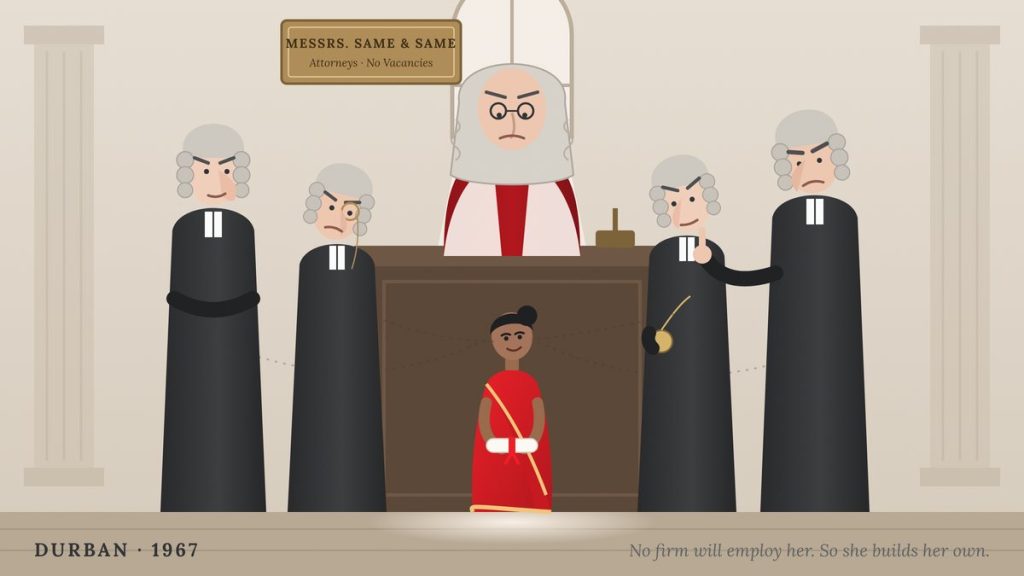
The year is 1967. You are in Durban, South Africa. The ink on your law degree is barely dry. Your father drives a bus. Your community passed the hat so you could study. You knock on the door of one law firm after another. Wood-panelled offices, brass plaques, men in dark suits who look at your face and your sari and see everything except a lawyer. Not one will hire you. Their excuse: their white staff could never take instructions from someone who looks like you. You are not even allowed to set foot in a judge's chambers. You walk home, sit down with your family, and say the words that change everything: "Then I will start my own."
Fast forward. It is October 9, 2026. The phone rings, and the voice on the line is calling from Oslo. The young woman no firm would employ has just been awarded the Nobel Peace Prize. Her first question is whether it is really true.
What happened
Navi Pillay, born in 1940, earned her law degree from the University of Natal in 1965. In 1967 she opened her own practice, the first woman of colour to do so in Natal, after being refused by established firms. She defended anti-apartheid activists, fought for the rights of political prisoners on Robben Island, and in 1995 became the first woman of colour on South Africa’s High Court. She later presided over the Rwanda tribunal that established rape as a crime of genocide, and served as UN High Commissioner for Human Rights. Reflecting on those apartheid years, she once said “the first time I entered a judge’s chambers was when I entered my own.” Today, at 85, she received the Nobel Peace Prize.
Now, think of your own closed doors. The recruiter who never called back because of the gap. The interview where they looked at your date of graduation and did the math. The voice that says the market isn't built for someone like you.Navi Pillay heard that voice too. Then she stopped asking for permission and built the room she was refused entry to. For women returning after a break, entrepreneurship is a real path, not a consolation prize: a consulting practice, a freelance studio, a small firm built on the skills and judgment you already carry. Hang your own plaque. And never let anyone tell you it is too late. She just proved it at 85.
Your brain screams no, no, no. Then, in one aligned moment, it says yes, and the world quietly rearranges itself.
What I want every returner to hear
Put the first three stories side by side. Women are wary of AI. Women are missing out on AI’s best-paid jobs. And employers are finally building real pathways back. The gap between those facts is where your next chapter lives.
At Unbound we’ve watched more than 70 women come back through our Whisperer program, and over three quarters are now in roles as Scrum Masters, Business Analysts, test automation engineers and Java developers. None of them came back by waiting until they felt ready. Like that captain, each of them opened a door, and found people in their corner on the other side.
So here is my practical advice for this month:
- Spend 20 minutes a day with an AI assistant on real work. Draft an email, summarize an article, plan a project. Fluency comes from use, not reading about it.
- Use your skepticism as a skill. Learn where AI gets things wrong. Checking its work is exactly the judgment employers need and can’t find.
- Name your break with confidence. One clear sentence about why you stepped away, then move to what you bring now.
- Consider building your own door. If the job market keeps you waiting, a consulting or freelance practice built on your experience is a legitimate way back in.
- Don’t do it alone. A cohort, a mentor, one friend on the same path. Confidence is rebuilt in company.
And to employers
The talent you’re struggling to find may be sitting at a kitchen table, wondering whether she’s still relevant. She is. Read the gap as experience, not absence. Give returners structure and a fair first conversation, and you’ll get loyalty and judgment that’s hard to hire any other way.
Be Unbound
Vidya
Founder & CEO, Unbound Solutions
Be Unbound
Vidya
Founder & CEO, Unbound Solutions
Thinking about coming back?
Talk to a real person at Unbound about the next Whisperer cohort, or start with a free AI session built for returners.
Sources
- Axios: Women don’t like AI. They have reasons (Oct 8, 2026)
- IBTimes UK: AI Boom Could Widen the Gender Pay Gap as Women Miss Out on Its Fastest-Growing Jobs (Oct 5, 2026)
- Al Jazeera: 12 minutes of madness: How Flydubai pilot, passengers saved plane midfall (Oct 2, 2026)
- CBS News: Hero passenger on FlyDubai flight (Oct 4, 2026)
- Wikipedia: Navi Pillay
- Al Jazeera: Who is Navi Pillay, winner of the 2026 Nobel Peace Prize? (Oct 9, 2026)
- Business News This Week: Godrej Industries Group launches Gateway (Oct 9, 2026)